The duty class of a 40 ton gantry crane directly affects how long it can operate reliably under its intended working conditions. It determines the crane’s suitability for different lifting frequencies, load levels, operating hours, and work cycles. A crane designed for occasional heavy lifting may experience excessive wear if used continuously in a production environment, even when its rated capacity is never exceeded.
For a 40 ton gantry crane, selecting the appropriate duty class is therefore essential to controlling fatigue, mechanical wear, maintenance requirements, and long-term operating costs. Buyers and engineers should evaluate not only the maximum lifting capacity but also the average load, daily operating frequency, lifting mechanisms, travel movements, and required service life. A correctly matched duty class helps ensure that the crane’s structure and mechanical components can withstand the actual workload over time.
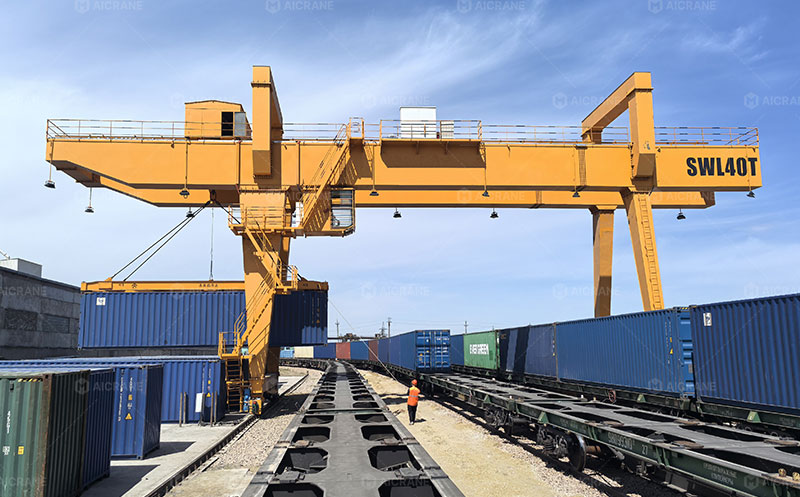
What Does Duty Class Mean for a 40 Ton Gantry Crane?
Duty class describes the expected operating intensity and workload that a crane is designed to handle. It considers how frequently the crane operates, how heavily it is loaded, and how its mechanisms are used throughout its service life.
A 40 ton gantry crane with a higher duty classification is generally designed for more demanding operating conditions than one with a lower classification. This may involve stronger or more fatigue-resistant structural components, appropriately sized motors, more durable transmissions, and lifting mechanisms designed for higher operating cycles.
Duty classification is not determined by lifting capacity alone. Two gantry cranes rated at 40 tons can have significantly different design requirements depending on their applications.
For example:
-
A crane in a precast concrete yard may lift heavy components several times per shift, with relatively long intervals between operations.
-
A crane in a steel fabrication workshop may perform repeated lifting, trolley travel, and gantry travel throughout the working day.
-
A crane in a heavy industrial production facility may operate across multiple shifts with frequent loading and unloading cycles.
Although all three cranes have a 40 ton rated capacity, their duty requirements can be very different.
How Is Crane Duty Classification Determined?
Crane duty classification is commonly evaluated using standards such as FEM and ISO 4301. These systems consider the overall operating spectrum and the utilization of individual crane mechanisms.
Two important considerations are:
1. Total operating cycles
A working cycle generally includes lifting a load, moving it to the required position, lowering it, and returning the lifting equipment to its initial position.
The number of cycles over the crane’s expected service life helps determine its utilization level.
2. Load spectrum
Load spectrum describes how frequently the crane handles different load levels.
For example, a double girder gantry crane that frequently lifts loads close to 40 tons experiences a different loading pattern from one that mostly handles 10–15 tons, even if both occasionally reach full capacity.
Duty classification therefore considers both how often the crane operates and how heavily it is loaded.
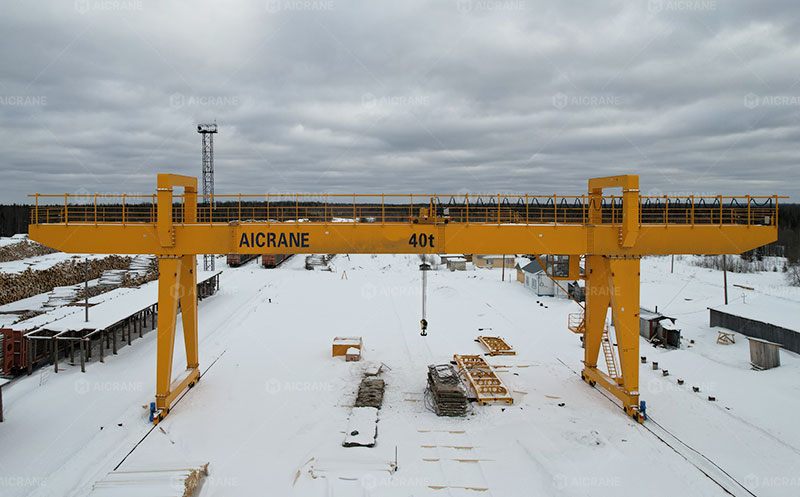
What Are the Common Duty Classes for a 40 Ton Gantry Crane?
Crane duty classifications vary depending on the applicable standard and the classification system used. Under commonly referenced FEM classifications, crane groups range from relatively light-duty applications to very heavy-duty operations.
The following examples illustrate how different duty levels relate to practical gantry crane applications.
FEM A3–A4: Light to Moderate Duty
A 40 ton gantry crane in the A3 or A4 range may be suitable for applications involving intermittent lifting and moderate operating frequency.
Typical applications include:
-
Precast concrete yards with scheduled lifting operations.
-
Equipment installation and maintenance areas.
-
Industrial storage yards with irregular heavy-load handling.
-
Workshops where heavy components are moved periodically.
These applications may involve substantial individual loads but relatively limited operating cycles.
A lower duty classification does not mean that the crane cannot lift 40 tons. It means that its structural and mechanical systems are designed around a less intensive operating spectrum.
If the crane begins operating more frequently than originally planned, its components may experience greater fatigue and wear than anticipated.
FEM A5–A6: Medium to Heavy Duty
A3? No. A5 and A6 classifications are more appropriate starting points for evaluating cranes used in demanding industrial operations.
Typical applications include:
-
Steel fabrication and processing facilities.
-
Precast concrete production lines.
-
Heavy equipment manufacturing.
-
Industrial loading and unloading yards.
-
Construction component handling facilities.
A 40 ton gantry crane in this range may need to perform repeated lifting operations, frequent trolley movements, and regular long-distance travel.
The lifting mechanism, wheels, bearings, brakes, and drive systems must be selected to withstand the expected operating cycles.
FEM A7–A8: Very Heavy Duty
A7 and A8 represent very demanding duty classifications.
They may be relevant to specialized production environments where heavy duty gantry cranes operate frequently, handle substantial loads, and experience high utilization over extended operating periods.
Potential applications include:
-
Intensive steel production operations.
-
Heavy industrial manufacturing.
-
Continuous production-related material handling.
-
Specialized facilities with high-frequency lifting requirements.
Not every 40 ton gantry crane requires A7 or A8 classification. Higher duty classes also involve different design and investment requirements.
The correct selection depends on the actual operating spectrum, rather than simply choosing the highest available classification.
How Does Duty Class Affect the Service Life of a 40 Ton Gantry Crane?
Duty class affects service life primarily by determining how much fatigue and mechanical wear the crane is designed to withstand.
A crane operating within its specified duty class is more likely to maintain its intended performance over its design life. When the actual workload exceeds the original design assumptions, structural fatigue and component deterioration may accelerate.
Several areas are particularly important.
1. Structural Fatigue and Girder Service Life
The main girder is one of the most important load-bearing components of a 40 ton gantry crane.
Every lifting operation produces stresses in the girder, end beams, supporting legs, and connecting structures. Repeated loading and unloading create stress cycles that can gradually lead to fatigue damage.
A higher-duty crane may require:
-
Structural sections designed for the expected fatigue spectrum.
-
Appropriate plate thickness and connection details.
-
Adequate resistance to local and global buckling.
-
Properly designed welded joints.
-
Fatigue assessment of critical structural connections.
The design must consider more than the maximum 40 ton lifting load. The frequency and distribution of loads are equally important.
For example, a 40 ton crane used occasionally in a storage yard may experience relatively few high-load cycles. The same crane used throughout multiple production shifts may accumulate substantially more stress cycles.
Even when neither crane exceeds its rated capacity, the second crane may experience greater cumulative fatigue damage.
2. Hoisting Mechanism Wear
The hoisting mechanism is directly affected by lifting frequency, load level, and operating duration.
Its main components include:
-
Hoisting motors.
-
Gearboxes.
-
Wire ropes.
-
Drums and sheaves.
-
Brakes.
-
Bearings and couplings.
Repeated lifting generates mechanical wear and thermal stress. Frequent starts and stops can also increase the workload on motors, brakes, and transmission components.
A 40 ton gantry crane operating under A3 conditions may require a different hoisting mechanism configuration from one designed for A6 or A7 service.
For higher-duty applications, engineers may need to consider larger motor capacities, appropriate thermal ratings, more durable braking systems, and suitable rope reeving arrangements.
The goal is to ensure that the hoisting mechanism can complete the required operating cycles without excessive overheating or premature component deterioration.
3. Trolley and Gantry Travel System Life
A 40 ton gantry crane does more than lift loads vertically. Its trolley and gantry travel systems also experience repeated mechanical loading.
Trolley travel involves movement along the main girder, while gantry travel moves the entire crane along the ground-level runway.
The associated components include:
-
Travel motors and gearboxes.
-
Wheels and wheel axles.
-
Bearings.
-
Rail systems.
-
Braking equipment.
-
Electrical and control systems.
Frequent travel movements increase the number of operating cycles experienced by these components.
In a steel stockyard, for example, the crane may need to move between several loading positions during each shift. This creates additional travel cycles even when the lifting load remains relatively constant.
Selecting the correct duty class helps engineers account for these movements when sizing the travel mechanisms.
4. Electrical Components and Control System Reliability
Electrical systems also influence crane service life.
Frequent motor starts, acceleration, braking, and reversing can increase electrical and thermal stress.
Important components include:
-
Motors and variable frequency drives.
-
Contactors and control cabinets.
-
Limit switches.
-
Encoders and position sensors.
-
Cable reels or other power supply systems.
-
Safety interlocks.
For high-frequency operations, the electrical system should be configured to support the required operating cycles.
Variable frequency drives can provide controlled acceleration and deceleration, helping reduce mechanical shock during starting and stopping. However, they do not automatically increase the crane’s duty classification. The complete system must be engineered for the intended workload.
Does a Higher Duty Class Always Mean a Longer Crane Service Life?
No. A higher duty class does not automatically guarantee a longer service life.
It means that the crane is designed for a more demanding utilization and load spectrum under the applicable classification requirements.
Actual service life also depends on several operating and environmental factors.
Load conditions: Repeatedly lifting loads close to 40 tons creates a different fatigue pattern from handling lighter loads most of the time.
Operating frequency: More working cycles generally result in greater cumulative mechanical wear.
Maintenance quality: Poor lubrication, delayed wire rope replacement, incorrect brake adjustment, and neglected inspections can shorten component life regardless of duty class.
Environmental conditions: Dust, moisture, corrosive atmospheres, extreme temperatures, and outdoor exposure can accelerate deterioration.
Operating practices: Sudden braking, diagonal pulling, shock loading, and improper load handling can introduce additional stresses.
A properly maintained A5 crane operating within its design conditions may provide more reliable service than an A7 crane that is regularly overloaded or poorly maintained.
Duty class should therefore be considered a design requirement, not a substitute for proper operation and maintenance.
How Should Buyers Select the Right Duty Class for a 40 Ton Gantry Crane?
Selecting the correct duty class requires a detailed understanding of the intended application.
Industrial buyers should provide operating information during the initial engineering stage rather than specifying only a 40 ton lifting capacity.
1. Determine the Actual Load Distribution
Start by identifying the typical loads handled by the crane.
For example:
-
Maximum lifting load: 40 tons.
-
Typical operating load: 15–25 tons.
-
Occasional lifting load: 30–40 tons.
These figures are illustrative. Actual load distribution should be established using production records or expected operating requirements.
If most lifting operations involve loads close to the rated capacity, the crane may require a higher duty classification than one that occasionally reaches 40 tons.
2. Calculate Daily Operating Cycles
Estimate how many lifting cycles the crane performs per hour, shift, and year.
Consider the following example:
A crane operates 8 hours per day and performs an average of 10 lifting cycles per hour.
Its estimated annual operating cycles would be:
10 cycles/hour × 8 hours/day × 250 working days/year = 20,000 cycles/year.
This is a simplified estimate. Actual crane classification requires a more detailed assessment of load spectrum, operating time, and the applicable standard.
If the facility later expands to two or three shifts, the annual utilization may increase significantly.
This possibility should be considered during the initial crane selection process.
3. Evaluate Hoisting and Travel Requirements Separately
The hoisting mechanism, trolley travel mechanism, and gantry travel mechanism may experience different utilization levels.
For example, a crane may lift loads frequently but travel only short distances. Another crane may perform fewer lifts but travel across a large outdoor storage yard throughout the day.
These differences can affect the required classification and sizing of individual mechanisms.
Engineers should evaluate each mechanism according to its actual operating conditions rather than assuming that all components experience identical workloads.
4. Consider Future Production Expansion
A crane should be designed around realistic future operating requirements.
If a manufacturing facility expects to increase production volume, the number of lifting cycles may rise even if the maximum lifting capacity remains unchanged.
Selecting a duty class based only on current production may result in insufficient operating capacity later.
However, choosing an unnecessarily high classification can increase initial investment and may require larger mechanical and electrical components.
The objective is to establish a suitable balance between present operating requirements, expected future utilization, and total lifecycle cost.
What Maintenance Practices Help Extend the Service Life of a 40 Ton Gantry Crane?
Correct duty classification provides the foundation for reliable operation, but maintenance determines whether the crane continues to perform as intended.
A structured maintenance program should address structural components, lifting mechanisms, travel systems, electrical equipment, and safety devices.
Structural Inspection
Regularly inspect the main girder, supporting legs, end beams, welded connections, and bolted joints.
Pay particular attention to:
-
Visible cracks or deformation.
-
Corrosion and material deterioration.
-
Loose or damaged connections.
-
Abnormal structural vibration.
-
Changes in wheel alignment or rail conditions.
Non-destructive testing may be required when inspections identify potential defects in critical structural areas.
Hoisting System Maintenance
Inspect wire ropes for broken wires, corrosion, deformation, and other rejection conditions specified by applicable standards.
Check the condition of drums, sheaves, brakes, gearboxes, and bearings.
Lubrication intervals should follow the manufacturer’s recommendations and account for actual operating intensity.
Travel Mechanism Maintenance
Inspect wheels, rails, bearings, couplings, and gearboxes.
Abnormal wheel wear, excessive vibration, and uneven travel may indicate alignment or mechanical problems.
For outdoor gantry cranes, rail foundations and drainage conditions should also be checked to prevent operational problems caused by uneven or deteriorating ground conditions.
Electrical and Safety System Testing
Check motors, variable frequency drives, electrical connections, limit switches, overload protection, emergency stops, and other safety devices.
Testing frequency should be determined by the equipment manufacturer’s maintenance instructions, applicable regulations, and operating conditions.
Maintenance records should include inspection dates, identified defects, corrective actions, and replaced components. These records help engineers identify recurring problems and determine whether the crane is operating within its intended duty classification.
How Does Duty Class Affect the Total Cost of a 40 Ton Gantry Crane?
Duty class influences both the initial purchase price and the long-term cost of ownership.
A higher-duty 40 ton gantry crane may require more robust structural components, higher-rated motors, upgraded transmissions, and more durable mechanical systems.
These requirements can increase the initial manufacturing and installation cost.
However, selecting a crane with insufficient duty capacity can create greater expenses over time through:
-
Premature component replacement.
-
Increased maintenance frequency.
-
Unexpected equipment downtime.
-
Production interruptions.
-
Structural inspection and repair costs.
For example, a 40 ton gantry crane designed for intermittent lifting may not be suitable for a facility that later operates three shifts with frequent heavy-load handling.
The initial purchase price may be lower, but the crane could experience excessive wear if its operating spectrum exceeds the original design assumptions.
Buyers should therefore compare cranes based on their expected lifecycle requirements rather than purchase price alone.
A practical evaluation should consider initial investment, operating hours, maintenance requirements, spare parts, expected production utilization, and downtime costs.
Frequently Asked Questions
Can a 40 Ton Gantry Crane Be Upgraded from A5 to A6?
An A5 crane cannot automatically be upgraded to A6 simply by replacing its motor or gearbox.
A duty-class upgrade requires an engineering assessment of the complete crane, including its main structure, lifting mechanism, trolley, travel systems, brakes, wheels, and electrical components.
The assessment must determine whether the existing design can safely accommodate the higher operating spectrum and fatigue requirements.
In some cases, extensive modifications or a new crane may be necessary.
Does Lifting 40 Tons Once a Day Require A7 Duty Class?
Not necessarily.
A crane that lifts 40 tons once a day may operate under a relatively moderate duty classification, depending on its other lifting operations, load spectrum, total operating hours, and travel frequency.
The maximum lifting load alone cannot determine the required duty class.
What Is the Difference Between Lifting Capacity and Duty Class?
Lifting capacity indicates the maximum rated load that a crane can safely lift under its specified operating conditions.
Duty class indicates the intensity of operation that the crane is designed to withstand over time.
For example, two 40 ton gantry cranes may have identical lifting capacities but different duty classifications because they serve different production requirements.
Both specifications must be considered when selecting a crane.
Which Duty Class Is Suitable for a 40 Ton Gantry Crane in a Steel Yard?
A5 or A6 may be appropriate starting points for evaluating a 40 ton gantry crane in a steel yard with regular material handling.
However, the final classification depends on the frequency of lifting, load distribution, working shifts, travel distances, and production intensity.
A steel yard with intermittent loading operations may require a different configuration from one with continuous material handling.
How Long Can a 40 Ton Gantry Crane Last?
There is no universal service-life figure for all 40 ton gantry cranes.
Actual service life depends on the original design assumptions, duty classification, accumulated operating cycles, fatigue exposure, environmental conditions, maintenance quality, and replacement of worn components.
A crane that operates within its design limits and receives appropriate maintenance can provide reliable service over an extended period. Its remaining service life should be evaluated through inspections and engineering assessments rather than estimated from lifting capacity alone.
Conclusion
Duty class is a key factor in determining the long-term reliability and service life of a 40 ton gantry crane. It connects the crane’s structural design and mechanical configuration with the actual workload it must handle.
For industrial buyers, the most important consideration is matching the duty classification to the expected load spectrum, operating cycles, working shifts, and travel requirements. A3–A4 may suit intermittent heavy lifting, while A5–A6 and higher classifications should be evaluated for more intensive industrial applications.
Before purchasing a 40 ton gantry crane, provide the manufacturer with the maximum and typical lifting loads, estimated daily cycles, working hours, lifting height, span, travel distances, and operating environment. This information allows engineers to determine an appropriate duty classification and configure the crane for reliable long-term operation.