Government infrastructure projects, particularly highway and arterial road construction, demand a level of precision and durability that private residential projects rarely require. When a state entity in South America commissions a new transit vein, the contractors must ensure their equipment meets rigorous legal and technical standards. Selecting the right mobile concrete plant(planta de concreto móvil) is perhaps the most critical decision in this process. Because these projects often span hundreds of kilometers, the ability to move the production hub without compromising the “slump” or strength of the mix is paramount. In the following sections, we explore the vital parameters that ensure your machinery stays compliant and productive throughout the contract duration.
1. Mobility and Rapid Deployment Capabilities
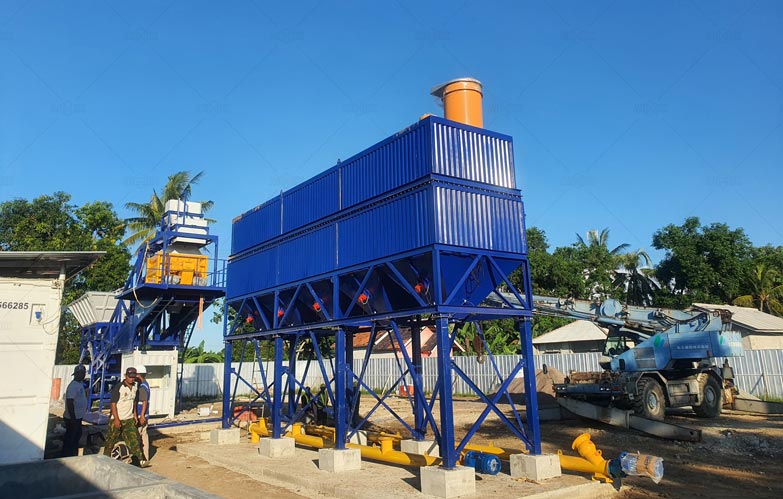
The primary reason for opting for a mobile concrete plant over a stationary one is the reduction in transit time for the concrete trucks. For government road projects, the “working window” for pouring concrete is often strictly regulated to minimize traffic disruption. Therefore, the plant must be capable of being dismantled, transported, and reassembled within a window of 24 to 48 hours. In the context of large-scale Peruvian infrastructure, this mobility allows the contractor to “hop” along the highway route, keeping the delivery radius under 15 kilometers to prevent premature setting of the mix.
In the rugged terrain where you might deploy a concrete batching plant Peru operators look for “foundation-free” designs. These units utilize a integrated steel frame that can be placed on compacted earth or a simple reinforced concrete slab, saving weeks of civil work. In high-speed road projects, the plant effectively follows the progress of the paving machine, moving every 20 to 50 kilometers to keep the logistics chain short, fuel costs low, and the concrete fresh. A plant that requires a permanent concrete foundation is not truly mobile and will incur massive decommissioning costs that eat into the project’s bottom line.
2. Precision of the Automated Batching and Control System
State auditors and ministry inspectors are notoriously strict regarding the “recipe” of the concrete. Whether it is H-30 or H-40 grade concrete for bridge abutments, the margin of error for cement and chemical additives is often less than 1%. A high-quality concrete plant must be equipped with high-precision load cells and a PLC (Programmable Logic Controller) that logs every single batch produced throughout the day.
For a concrete plant in Chile(plantas de hormigón en Chile), where seismic codes are among the strictest in the world, the batching system must prove its calibration history. Modern mobile units now feature cloud-based monitoring, allowing government inspectors to verify the mix quality in real-time from a remote office. This ensures total transparency and prevents the “watering down” of concrete, which is a common point of contention in public works. The software should also support multi-language interfaces and be capable of storing hundreds of different mix designs for quick switching between sidewalk, curb, and structural pavement requirements.
3. Mixing Technology: The Dominance of Twin-Shaft Systems
The “heart” of any concrete plant is the mixer. For road projects, where high volumes of low-slump (dry) concrete are required for high-speed paving machines, the horizontal twin-shaft mixer is the undisputed industry standard. This technology provides the necessary shear force to ensure a perfectly homogeneous mix in under 60 seconds. Unlike single-shaft or drum mixers, the twin-shaft design ensures that every pebble is coated in cement paste, which is vital for the longevity of the road surface.
While planetary mixers are excellent for specialized precast elements, the twin-shaft design is better suited for the high-intensity, continuous output needed for highway interchanges. When selecting your mobile concrete plant, ensure the mixer liners are made of high-chromium cast iron or specialized ceramic tiles to withstand the abrasive nature of the volcanic aggregates often found in the Andes. Wear and tear on the mixer paddles can lead to “dead spots” in the mix, which will cause a batch to fail an inspection—a costly mistake that can halt an entire project.
4. Environmental Compliance and Dust Suppression
Modern government contracts in South America now include heavy “Green” clauses and environmental impact assessments (EIA). Operating a concrete batching plant Peru(Operar una planta dosificadora de concreto Perú) requires strict adherence to particulate matter (PM10) emission standards. A mobile plant must feature an integrated pulse-jet dust collection system on top of the cement silos and at the mixer transition point to prevent “cement clouds” from drifting into nearby agricultural or residential areas.
Furthermore, water recycling systems are becoming mandatory in many regions. The ability to reclaim “gray water” from the truck washing process and reintroduce it into the mix (after proper sedimentation and pH balancing) can significantly lower the environmental footprint. This feature is particularly attractive for concrete plant in Chile operations located in the arid northern regions where water is a scarce and expensive resource. Being able to demonstrate environmental stewardship can often be the “tie-breaker” that wins a contractor a competitive government tender.
5. Adaptation to Extreme Altitudes and Thermal Variation
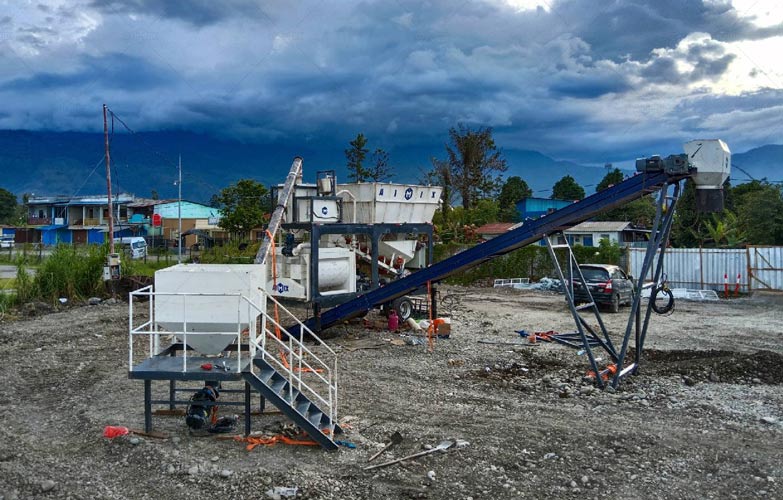
Geography plays a massive role in equipment selection. A concrete plant(planta de concreto) in Chile operating in the northern mining corridors may face extreme heat (40°C) during the day and freezing temperatures (-10°C) at night. Similarly, projects in the Peruvian highlands (Puno or Cusco) require engines and pneumatic systems that can function in low-oxygen environments at 4,000 meters above sea level.
Key technical features for these environments include:
- Heavy-duty air compressors with moisture separators to prevent air lines from freezing at night.
- Oversized cooling radiators for hydraulic systems to prevent overheating during summer peaks.
- Insulated control cabins with HVAC systems to ensure operator focus and safety during 12-hour shifts.
- Optional heating systems for the aggregate bins to prevent clumps of frozen sand from entering the mixer during Andean winters.
6. After-Sales Support and Component Standardization
No matter how robust the mobile concrete plant is, mechanical wear is an mathematical certainty. Government projects often carry heavy “liquidated damages” clauses—meaning the contractor is fined thousands of dollars for every day the project is delayed. Therefore, the global availability of spare parts is a critical parameter that many firms overlook in favor of a lower initial purchase price.
Ensure that the hydraulic pumps, electrical contactors, and pneumatic valves are from globally recognized brands like Schneider, Siemens, or Casappa. This ensures that if a sensor fails at a remote site in the Atacama Desert or the Amazonian jungle, a replacement can be sourced from a local distributor rather than waiting weeks for an international air-shipment. A concrete plant that sits idle for two weeks waiting for a $50 part is a liability, not an asset.